

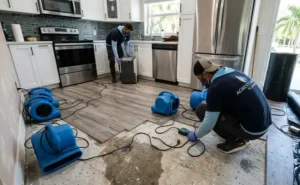
A minor line leak behind a refrigerator, dishwasher, or kitchen sink can quickly turn into a major structural headache requiring professional water damage removal. Because modern Florida homes widely feature luxury vinyl plank (LVP) or laminate flooring, water often runs beneath the surface, pooling directly on the concrete subfloor without showing immediate surface wetness.
If left untreated, trapped moisture warps floorboards, ruins kitchen cabinetry, and triggers rapid mold colonization. Below is a real-world look at how our technical team executes precision structural drying to salvage materials and restore kitchen spaces across Florida.
The Hidden Threat: Moisture Trapped Beneath LVP Flooring
When a kitchen leak occurs, surface wiping is never enough. Water naturally migrates beneath non-porous floor planks, getting trapped over the concrete slab.
In our recent project, water intruded beneath the kitchen floor, threatening the surrounding white cabinetry and subfloor integrity. To prevent permanent warping and biological growth, our emergency response team implemented a targeted mitigation protocol:
- Selective Floor Board Removal: Carefully disassembling impacted sections of the floor without destroying surrounding planks or cabinet bases.
- Exposing the Subfloor: Revealing the wet concrete slab to allow direct, high-velocity airflow.
- Direct Air Injection Drying: Deploying commercial centrifugal air movers positioned at precise angles to drive moisture out of the building assembly.
Controlling Wall & Baseboard Moisture: Precision Demolition
Water rarely limits itself to horizontal floor surfaces; it wicks up drywall and baseboards through capillary action. To halt mold proliferation and dry internal wall cavities, non-salvageable drywall and damaged baseboards must be meticulously undercut.
Our technicians utilize precision multi-tools with integrated lighting to slice through baseboards and affected drywall edges without disturbing underlying studs or wiring. This controlled opening creates an airflow path for targeted cavity drying.
Why Specialized Equipment Is Required for Subfloor Extraction
Attempting to dry a subfloor with household fans or ambient AC running will fail in Florida’s high humidity. Specialized restoration equipment accelerates the evaporation rate through thermodynamic principles:
- Centrifugal Air Movers: Pushes laminar airflow across damp concrete surfaces to continuously break the boundary layer of saturated air.
- LGR Dehumidifiers: Removes evaporated water vapor from the surrounding indoor environment to prevent secondary moisture absorption into kitchen cabinets.
- Precision Moisture Monitoring: Tracking pin-less moisture meter readings daily until the subfloor reaches structural dry standards.
Frequently Asked Questions About Kitchen Water Damage
Do I need to replace my entire floor after a kitchen water leak?
Not always. If structural drying is initiated within the first 24 to 48 hours using high-velocity air movers, non-warped laminate or LVP planks can often be saved, and only the saturated subfloor needs direct drying.
How do I know if water got under my kitchen cabinets?
Common indicators include cupping floor planks, musty odors coming from toe-kicks, peeling cabinet laminate, or elevated moisture readings detected by thermal imaging devices.
Facing Hidden Water Damage Under Your Kitchen Floors?
Don’t wait for trapped moisture to ruin your subfloors and cabinets. If you suspect a hidden leak in your Florida home, contact our Florida water damage removal team today for 24/7 moisture inspections and emergency structural drying.